The authorities are buying time. We are not backing down.
On the last day of the legal deadline, the city hid behind paperwork. Instead of calling a referendum and asking its citizens, the city administration found trivial faults and asked for more time. Here is what really happened, and why we are not backing down.
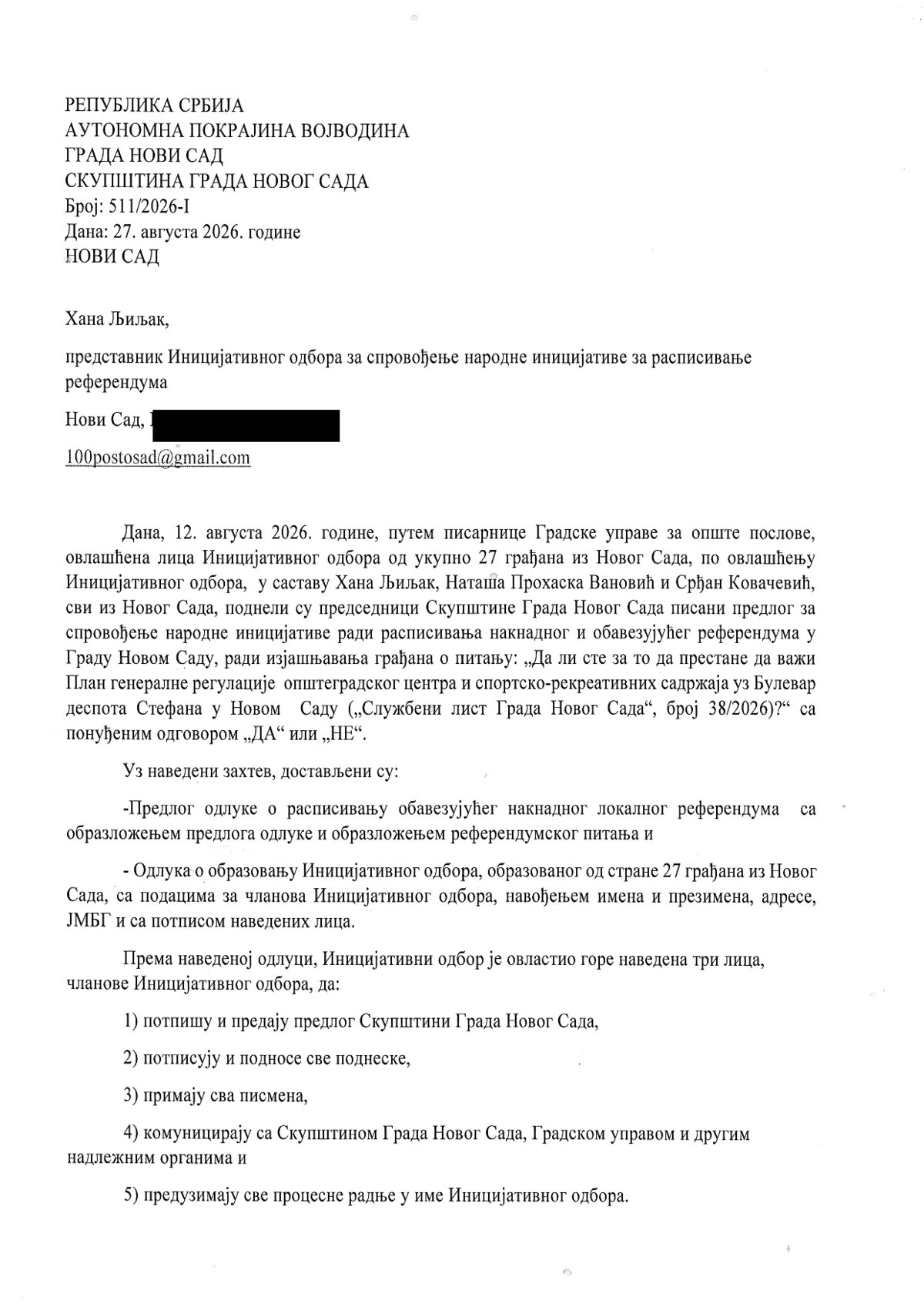
On 12 August 2026, the Initiative Committee of the citizens' initiative “100% Sad”, on behalf of 27 citizens of Novi Sad, submitted to the Assembly of the City of Novi Sad a request to call a binding subsequent local referendum. The question is clear: should the General Regulation Plan for the city centre and sports-recreational facilities along Despota Stefana Boulevard, the planning document that opens the door to the project known as “Novi Sad na vodi”, cease to be valid?
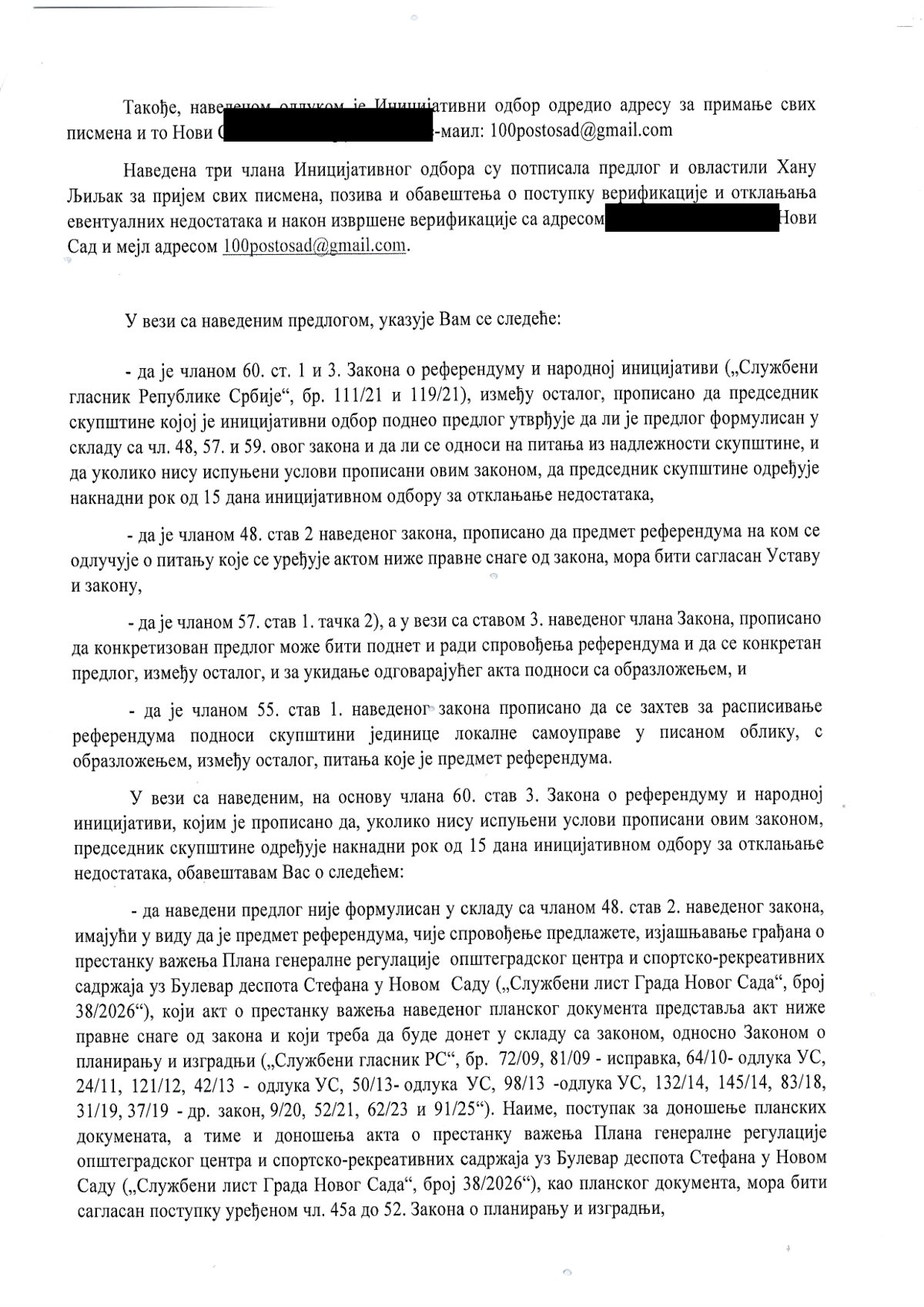
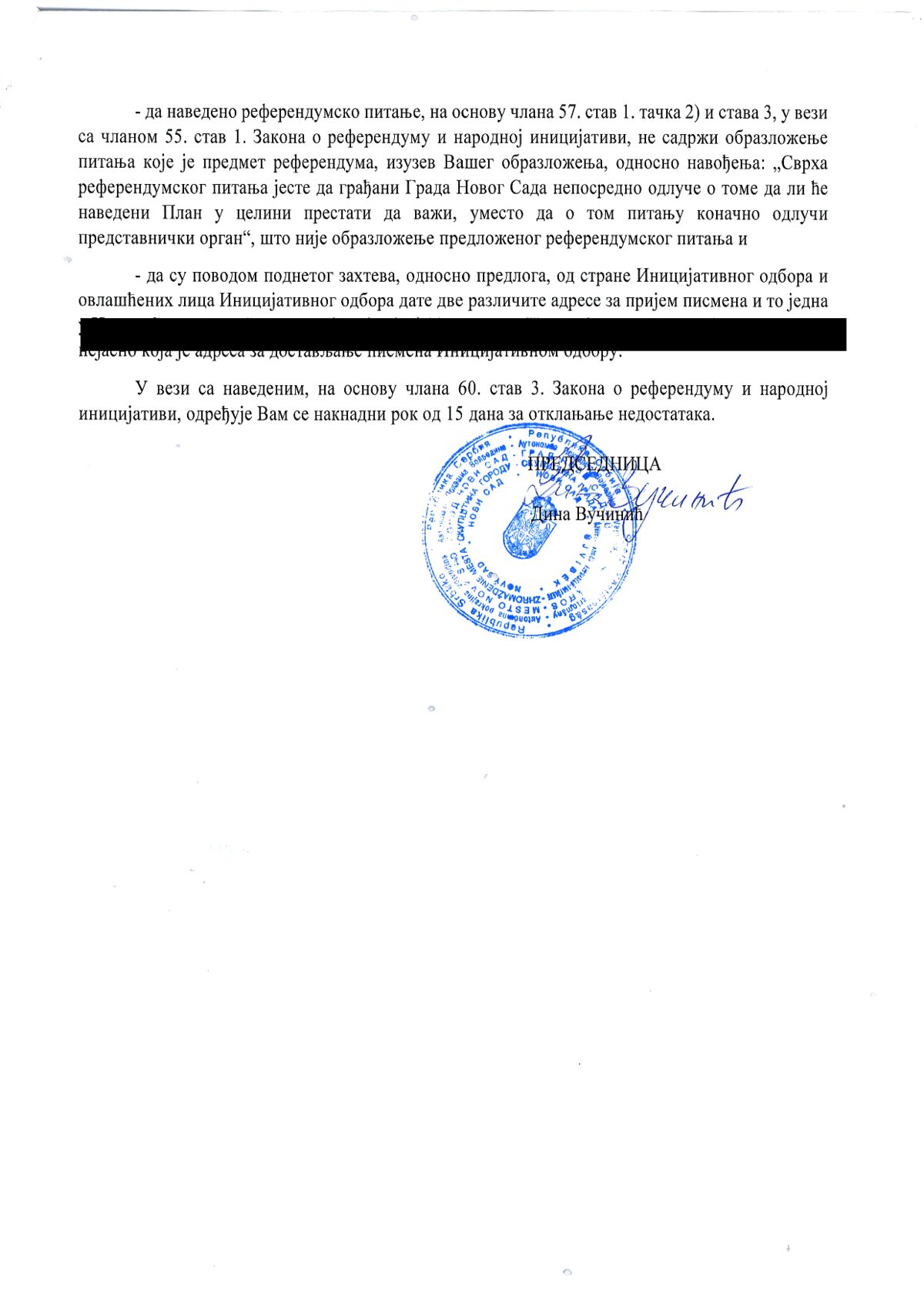
Instead of verifying the request, on the last day of the deadline, 27 August, the city authorities delivered a notice with objections and set an additional deadline, until 11 September 2026, to remedy them. This is not a rejection of the request, and the procedure is not over. But the way the objections are argued reveals far more than a legal dispute over a single document.
What the city claims
The city administration's central argument is this: for citizens to be able to vote on repealing the Plan, that Plan must first be repealed through a separate administrative procedure, the very same one by which the plan is adopted.
This interpretation is absurd at first glance. If an act repealing the Plan had to exist before the referendum, the Plan would already be repealed by the time citizens went to vote. What would they even be deciding on?
The Law on Referendum and Citizens' Initiative provides exactly the opposite of what the city claims: citizens have the right to decide directly, at a referendum, whether an act already adopted by the Assembly should cease to be valid, and only after they decide is the Assembly obliged, within a legal deadline, to align its acts with their will.
Citizens decide first. Then the authorities carry out their decision. Not the other way around.
Alongside this substantive objection, the notice also lists petty formal remarks, such as the fact that two addresses for receiving mail were given in the documentation. Such remarks do not call into question the meaning, the clarity or the seriousness of a request signed by 27 citizens of Novi Sad, but they show clearly how the city administration approaches the whole procedure: it does not seek one serious reason, but piles up trifles, one after another, to turn something into an obstacle.
Authorities that fear their citizens
Authorities that believe they act in the citizens' interest have no reason to fear their opinion. On the contrary, a referendum would be their chance to win, for their decision on “Novi Sad na vodi”, the public support and legitimacy that no session of the Assembly can give them. Instead, the notice was sent on the last possible day, with objections that, read carefully, do not prove the request is flawed, but that someone is looking for a way to delay the vote as long as possible.
This is the behaviour of authorities unsure they would win the citizens' votes if the question were put today. Were they sure, they would have no problem holding the referendum as soon as possible and thereby proving that the will of the people of Novi Sad stands behind the project, not merely the decision of a narrow circle within the city administration.
Authorities unable to do their job
What the city administration presents as a legal reason for delay in fact reveals something more serious than mere stalling: it reveals that the local authorities are unable to correctly apply their own regulations. The procedure governing how citizens exercise their right to a referendum is neither unclear nor disputed. It provides that citizens first decide directly on the fate of an act, and that only afterwards do the authorities align their decisions with that will. The city administration turned this order upside down, and did so in a document bearing the signature of its president.
A body whose basic job is to adopt and interpret the regulations on which the city's future depends should not misread even the most basic rule on how citizens exercise their right to vote. If it does so out of negligence, that is incompetence. If it does so knowingly, that is abuse. Neither speaks in favour of authorities the citizens entrusted to govern the city in their name.
That is why a referendum is the only way
The city assembly exists to represent the will of its citizens. When that same body fears that will and at the same time shows that it cannot, or will not, apply the law that protects it, it ceases to perform its basic function: to be the voice of the people of Novi Sad.
That is why this initiative is not a dispute over procedure. It is a test of whether, in Novi Sad, decisions about the city are truly made by its citizens, or by authorities who, when the moment comes to answer to voters for their decisions, hide behind paperwork.
What comes next
This is not the end of the procedure. Within the legal deadline, the Initiative Committee will respond to the objections raised and stand by the submitted request. The citizens' initiative continues.
Novi Sad deserves to have its future decided by its citizens, not by a narrow circle of people who fear their vote.
We are not giving up on the referendum.
Initiative Committee of the citizens' initiative “100% Sad”